01
End user
Signed in, browsed the catalog, submitted a printer request from a template, and checked the completion email.
ITSM evaluation, client-side trial
A client-side and admin review of the portal, SLAs, workflows, and AI, with a recommendation for the proof of concept.
The short version
I used the portal and the admin console during the trial. The catalog, roles, SLAs, and workflows are already built. The problems are in the setup.
The portal, the workflow model, and the AI are the strongest parts. The risks are configuration accuracy and email deliverability, not missing features.
Branded portal, template routing, Sera, and cross-team workflows. The catalog and roles are already set up for Propelled Brands.
What needs attentionEvery Xurrent email landed in Gmail Spam. The time zone and SLA targets also disagree with the service offering.
What I recommendA three-test proof of concept. Prove the weekend ticket, one cross-team handoff, and inbox placement before a full rollout.
Scope
The trial covered the end-user journey, the admin configuration Sean will own, and the workflow and AI layer.
Signed in, browsed the catalog, submitted a printer request from a template, and checked the completion email.
Added manager roles, moved the test user into the covered organization, and reviewed SLAs, coverage, and capability usage.
Reviewed onboarding and equipment workflows, added a Tech Services task, activated the Triage Agent, and ran Sera Assist.
Findings
These are the parts I would put in front of a franchisee or a new technician.
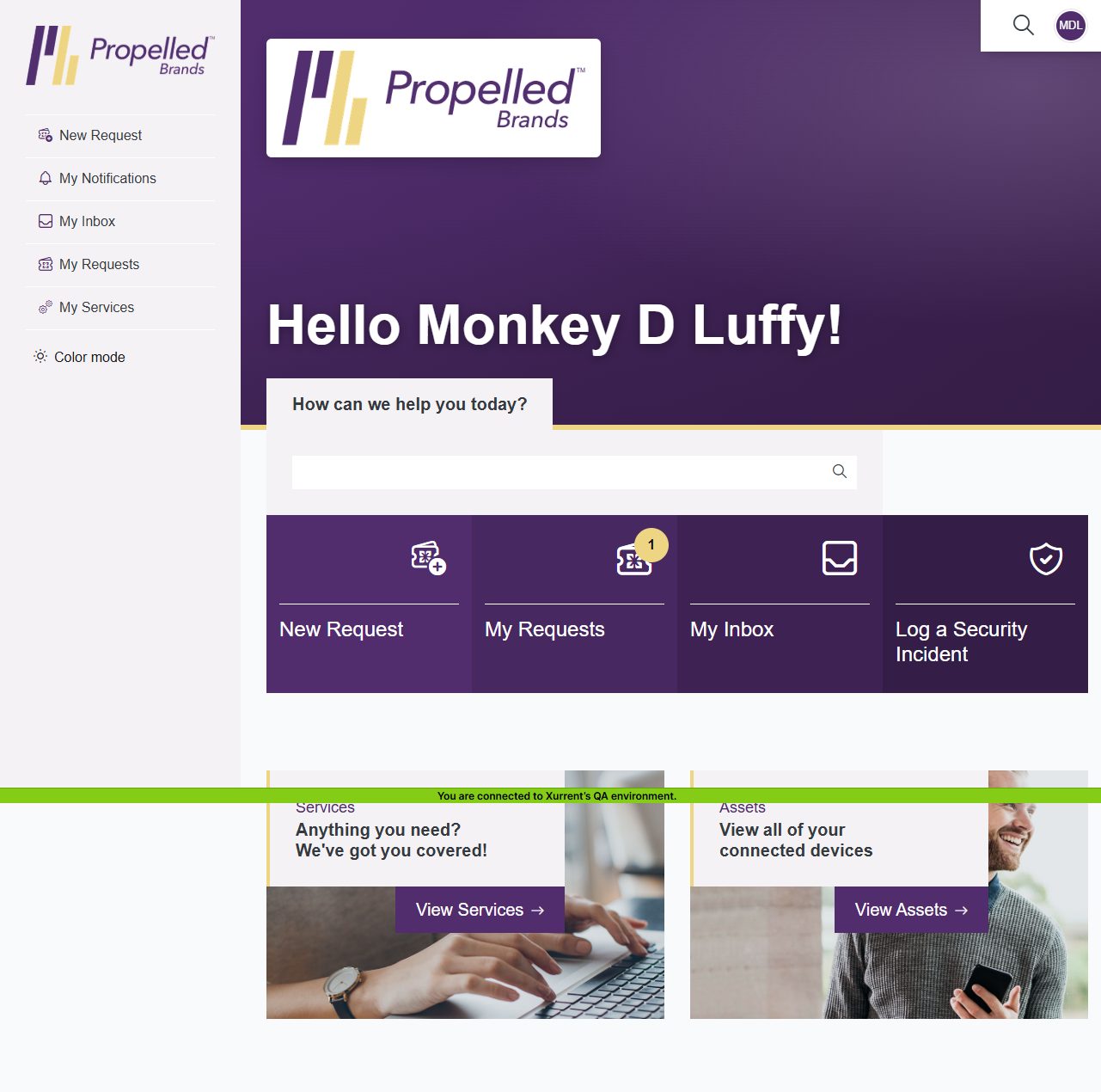
Once the test user was moved into the covered organization, 11 services appeared. The catalog is two levels: service, then service instance, then request template.
The empty catalog was a coverage problem. The catalog itself was fine.
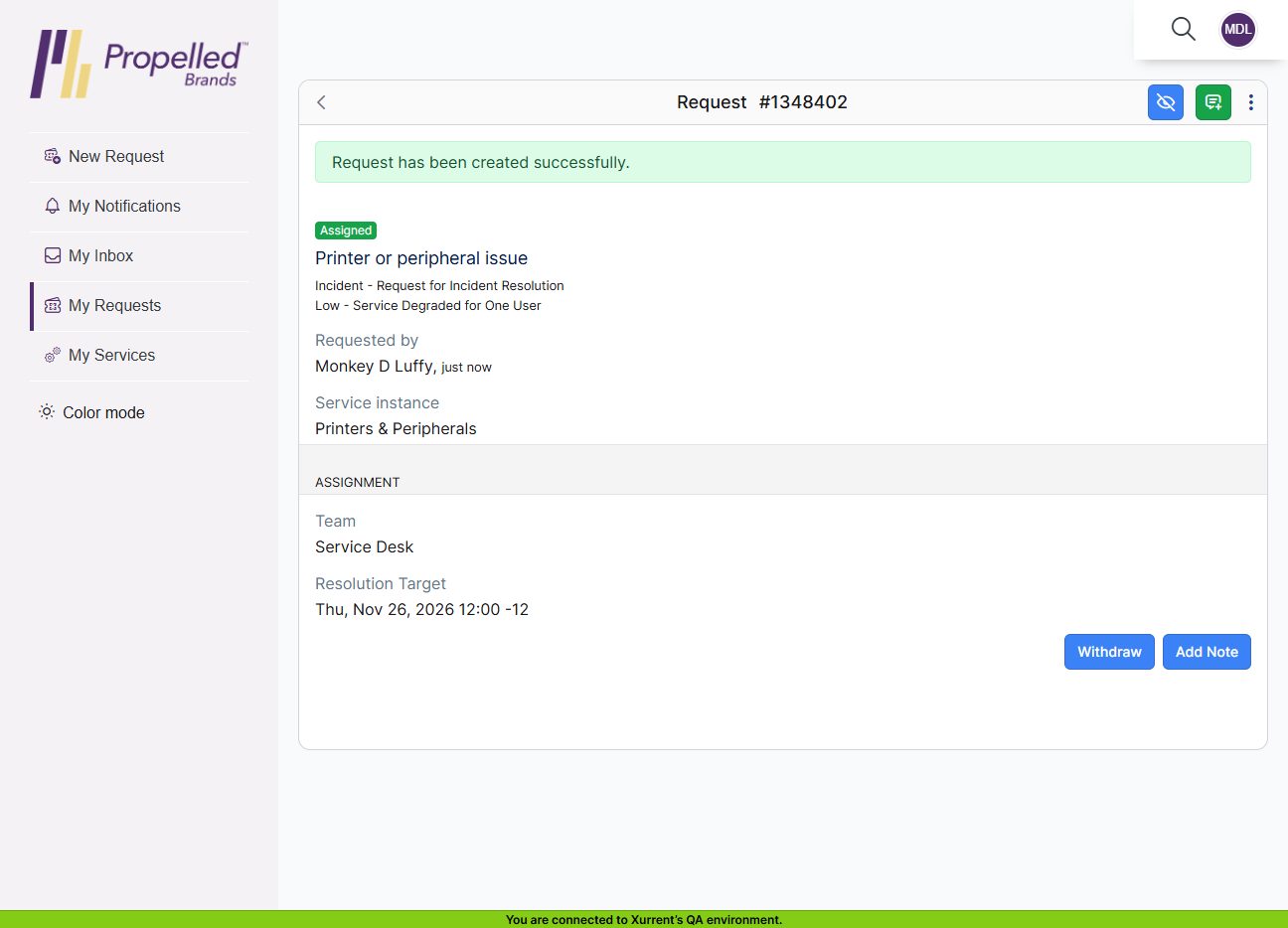
A printer request submitted from the catalog came in as Incident, Low impact, assigned to the Service Desk, with a real resolution target. A subject-only request in the same tenant fell back to Out of Scope and Best Effort.
That difference is why the catalog matters.
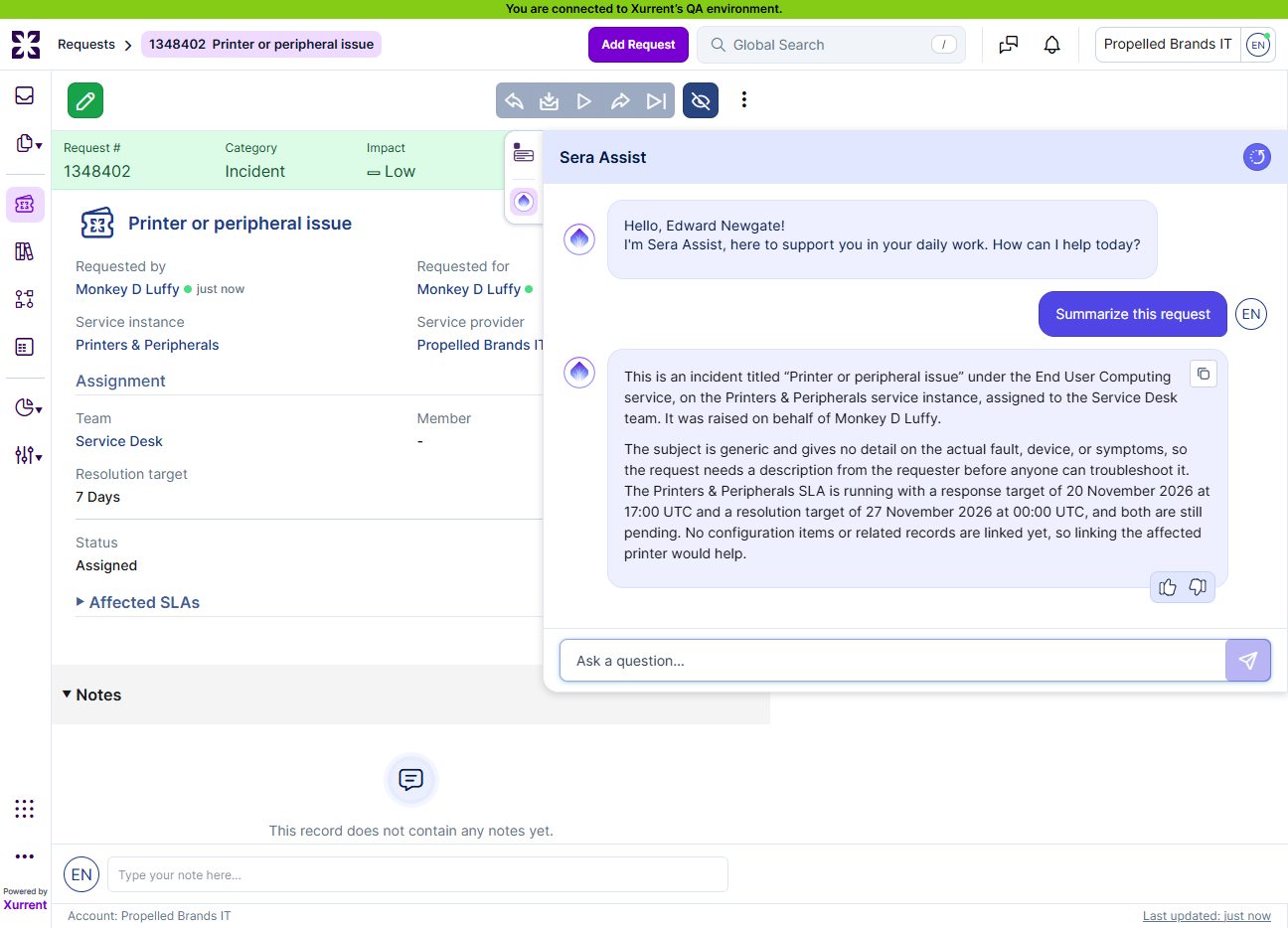
On a deliberately thin request, Sera named the service, the team, the requester, and the missing detail. It quoted the response and resolution targets and suggested linking the affected printer as a configuration item.
Sera did this on a request with almost no detail.
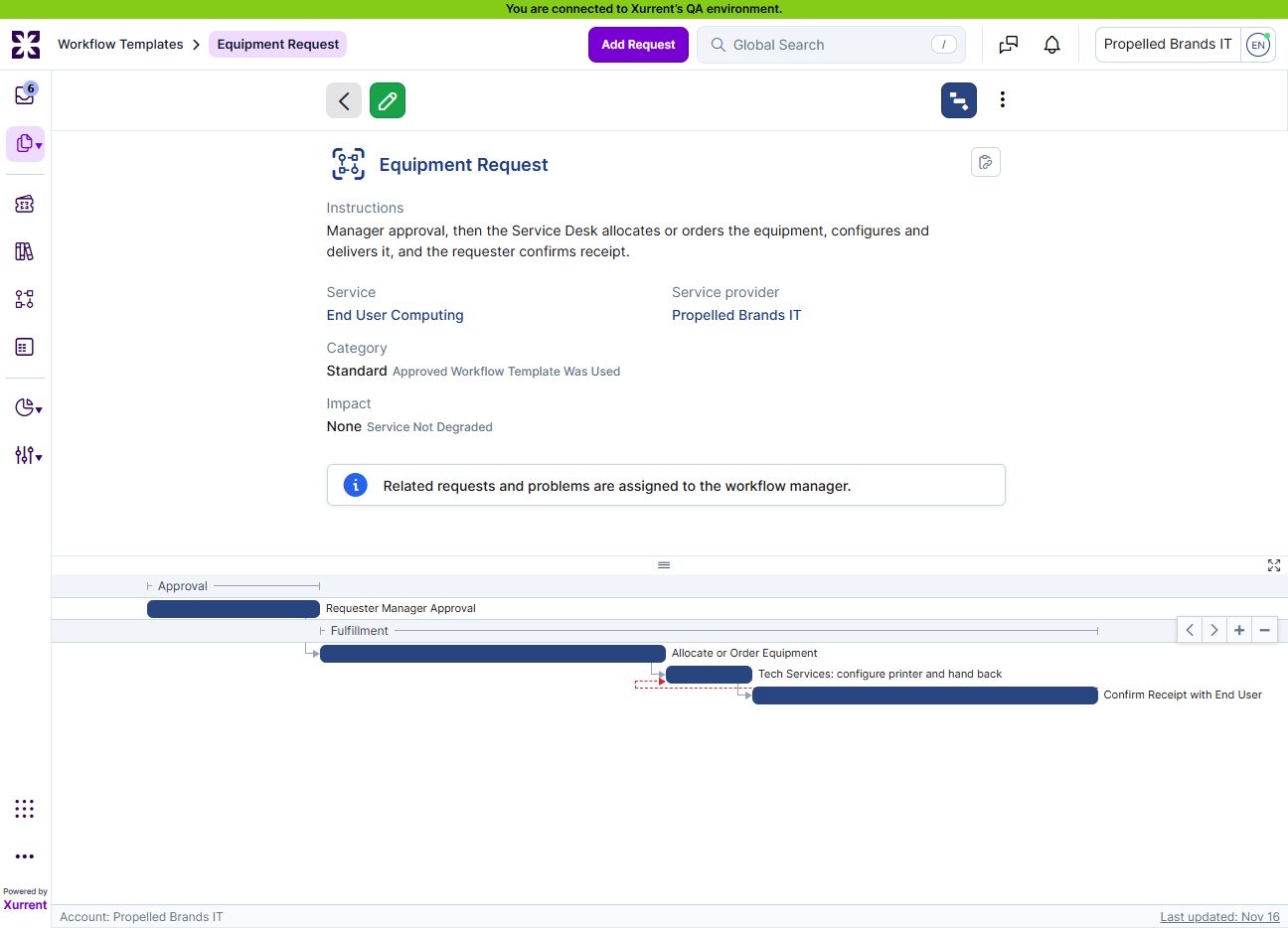
The Equipment Request workflow now sends a task to Tech Services to configure the printer and hand it back. The Triage Agent is also active for the Service Desk, with duplicate detection, CI linking, and impact assessment.
The handoff model matches the ONYX printer scenario Zac described in the demo.
Risks
These are the three things the proof of concept should prove.
Every Xurrent message landed in Gmail Spam, including the completion email. Gmail also showed a yellow warning that the sender may be impersonating Propelled Brands IT Service Desk.
The account time zone is International Date Line West (UTC-12) while service hours are Central. The live request showed a 12-hour response and 7-day resolution; the offering says 2 hours and 2 business days.
Google SSO and SCIM are untested. Google Workspace will enforce 2-Step Verification from 3 December 2026, which changes the login experience for every user.
Risk and controls
How the trial looks to risk, compliance, and security. I looked at access, audit, email, identity, and reporting.
| Control area | What we saw | Why it matters | Next step |
|---|---|---|---|
| Access and roles | Account administrator could not edit services, SLAs, or workflows until five manager roles were added. | The role setup decides who can change services, SLAs, and workflows. Too much access is a risk. Too little blocks the owner. | Build a least-privilege role matrix with Sean before rollout. |
| Audit trail | Completion email logged with recipient, template, and timestamp. Notes history shows who completed the request. | Supports incident review, audit requests, and dispute resolution. | Test export, retention, and search against a real audit request. |
| Email security | Sender is noreply@us.xurrent.qa. Gmail flags impersonation and tells users not to click or reply. | People will not trust a support email that looks like phishing. | Authenticated sending domain and an inbox placement test. |
| Identity | SSO and SCIM untested. Google 2SV enforcement begins 3 December 2026. | Access control and onboarding depend on this working. | SSO pilot with the test user; confirm SCIM or plan CSV lifecycle. |
| SLA integrity | Time zone is UTC-12; live targets do not match the service offering. | Reports could misstate performance to a franchisee or an auditor. | Fix the time zone and re-test a weekend ticket. |
| Vendor data handling | QA tenant. AI features are confined to the account, per the vendor. | The security review needs documents. | Request SOC 2 / ISO reports and an AI data-flow questionnaire. |
For Michael
Mapped to the Four Houses: purpose, people, process, and platform. The case is fewer handoffs, faster triage, and a service model that scales across brands.
Faster, safer service for corporate staff and franchise locations, with SLAs that reflect how each brand actually works.
Less triage toil for the Service Desk. More time for judgment, customer conversation, and the work that needs a human.
Template intake, cross-team handoffs, and SLA discipline in one record. The ONYX printer handoff is the first proof.
One service model, AI agents that can be switched on per team, and open access through REST, GraphQL, and MCP.
The Triage Agent is active but has not run yet. The trigger is the next thing to prove. I would measure time to triage, first-contact resolution, SLA attainment, agent minutes saved, and inbox placement.
Evidence
Eight moments from the trial. Select any image to enlarge it. The full appendix has 28 screenshots and the raw completion email.
Walkthroughs
The first follows a request from the end user to the agent. The second shows how the trial was configured.
End-user submission, then the agent view and the Sera summary. 1 minute 41 seconds.
Roles, SLA coverage, the Triage Agent, and the cross-team task. 2 minutes 30 seconds.
Recommendation
The product has earned a serious comparison. It has not earned a rollout. These three tests decide whether it should.
A request logged after hours lands on the right business day, with an SLA target that matches the offering.
One workflow runs from Service Desk to Tech Services and back, with a clean audit trail and no lost notes.
A completion email from Xurrent reaches a fastsigns.com inbox, not Spam, with no impersonation warning.
If those three pass, Xurrent earns a serious comparison against the other two trials. If they fail, we have saved ourselves a long implementation.